




M5531R2LJAE
Powered by Cortex®-M55 core,speeds of up to 220 MHz
Supplier:
Nuvoton
Certification:


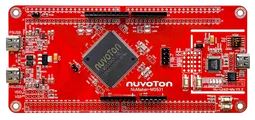
The NuMicro® M5531 series stands as a powerful microcontroller (MCU), purpose-built to deliver lifted performance in digital signal processing. This strength is effectively enabled by its Arm® Cortex®-M55 processor, at speed of up to 220 MHz. Its operating voltage ranges from 1.71V to 3.6V while its operating temperature ranges from -40°C to +105°C.
Enhanced compute capability
This M5531 series incorporates up to 1.5 MB of SRAM and 2 MB of Flash Memory directly on the chip, along with SPIM interfaces for accommodating expanded RAM and ROM requirements. Its abundant compute resources, including DSP extensions, vector extensions (Helium), double-precision FPU, 2 sets of 16-channel PDMA controllers, 1 set of 2-channel GDMA(Graphic Direct Memory Access) controller, and ample SRAM and Flash Memories, make it ideal for compute-intensive embedded applications like real-time signal processing, high-performance control systems, sensor fusion, industrial automation, and communication systems.
Strengthened security measures
Security is another pivotal consideration for the M5531 series, featuring advanced security features such as secure boot, Arm TrustZone®, true random number generator (TRNG), key derivation function (KDF), key store, AES/ECC/RSA/SHA/HMAC cryptography accelerators, and Arm PSA CertifiedTM Level 2 compliance. These robust security measures significantly enhance the security and integrity of systems built with the M5531 series.
Abundant control functions
For analog and control functions, the M5531 series implements 2 sets of 12-bit SAR ADC, 2 sets of 12-bit 1 Msps DAC, 4 sets of analog comparators (ACMP), 1 set of built-in temperature sensor, 1 set of internal voltage reference generator, up to 24-channel PWM outputs, 4 sets of QEI, and 4 sets of input capture units.
Rich connectivity peripherals
The M5531 series also provides a wide array of communication and peripheral interfaces, including one set of Universal Serial Control Interface (USCI), which can be configured as UART/SPI/I²C with flexibility, 10 sets of UART, 4 sets of SPI/I²S, 4 sets of I²C, 1 set of I3C, 2 sets of CAN FD, 2 sets of QSPI, 2 sets of independent I²S, 1 set of USB 2.0 high-speed OTG/Host/Device with PD (Power Delivery) function and supporting USB Type-C connector, 1 set of USB 2.0 full-speed OTG/Host/Device, 1 set of 10/100 Ethernet MAC with RMII interface, 1 set of 8-bit parallel image sensor interface (CCAP), 1 set of 4-channel PDM microphone interface controller (DMIC), 3 sets of ISO-7816-3 smart card interfaces, and 2 sets of SDIO.

The M5531 series benefits design of a wide range of applications such as:
- IIOT
- Industrial Automation
- Human Machine Interface
- Communication Systems
- Sensor Fusion
- Smart Appliances
Key features:
Operating Characteristics
Voltage range: 1.71V to 3.6V
Temperature range: -40°C to +105°C
ESD HBM ±3 kV
EFT ±4.4 kV
Latch Up: ±200 mA
[Core]
Arm Cortex-M55 core, running up to 220 MHz
Arm M-profile vector extension enabled (Helium)
IEEE 754 compliant floating-point unit (FPU) supporting vector and scalar half-, single-, and double-precision floating-point calculations
Arm TrustZone technology including an 8-region secure memory protection unit and an 8-region non-secure memory protection unit
Arm custom instructions (ACI) implemented for accelerating specific math operations
L1 cache: 16 KB instruction cache (I-cache) and 16 KB data cache (D-cache)
[Memories]
Secure Boot ROM (MaskROM): 24 KB
APROM Flash: 2 MB (dual banks of 1MB each)
LDROM Flash: 8 KB
OTP Flash: 3 KB
XOM (Execution-only memory): 4 regions
SRAM0: 512 KB
SRAM1: 512 KB
SRAM2: 320 KB
SRAM3: 8 KB
LPSRAM: 8 KB
I-TCM(Tightly Coupled Memory) : 64 KB
D-TCM(Tightly Coupled Memory) : 128 KB
External Memory Interface
SPIM (with HyperBus interface) supporting SPI Flash, QSPI, OSPI, and HyperFlash memories up to 32 MB, featuring AES on-the-fly decryption
External bus interface (EBI) supporting 8- or 16-bit data width, i80 mode LCD interface, and up to three sets of 1 MB memory banks
Clocks
4~32 MHz high-speed external crystal oscillator
32.768 kHz low-speed external crystal oscillator
48 MHz high-speed internal RC oscillator
12 MHz high-speed internal RC oscillator with 2% deviation
1~8 MHz high-speed internal RC oscillator
32 kHz low-speed internal RC oscillator
2 sets of programmable APLL, up to 480 MHz
Direct Memory Access (DMA)
2 sets of 16-channel PDMA controllers
1 set of 2-channel GDMA(Graphic Direct Memory Access) controller (DMA-350)
1 set of 4-channel LPPDMA controller
Security Functions
Secure Boot
Key derivation function (KDF)
Cryptography accelerator including algorithms up to AES-256, ECC-571, SHA-512, HMAC-512, RSA-4096, and a pseudo random number generator (PRNG)
True random number generator (TRNG)
Key store module for key management, including a dedicated Key store SRAM buffer
Four eXecute-Only-Memory (XOM) regions for code protection
Write protection in Flash memory
Power Management
Active power: 94.5 μA/MHz at 220MHz
Normal power-down (NPD4) with 64 KB SRAM retention: 12.5 μA at 3.0V
Standby power-down (SPD1) with 64 KB SRAM retention: 6.1 μA at 3.0V (SRAM retention up to 64/128/192/256/320/384/448/512 KB)
Deep power-down (RTC on): 0.64 μA at 3.0V (LIRC)
RTC (VBAT): 0.36 μA
Power-on reset
Brown-out reset
Low voltage reset
Built-in LDO voltage regulators
Timer and Control Peripheral
4 sets of 32-bit timers, supporting PWM function
2 sets of 32-bit low power timers, supporting PWM function
2 sets of tick timers
1 set of 24-bit count-down SysTick timer
2 sets of watchdog timers
2 sets of window watchdog timers
Up to 12 enhanced PWM (EPWM) outputs generated by twelve 16-bit counters
Up to 12 basic PWM (BPWM) outputs generated by two 16-bit counters
Up to 4 sets of enhanced quadrature encoder interfaces (EQEI)
Up to 4 sets of enhanced input capture unit (ECAP)
Connectivity Interfaces
Up to 10 sets of UART interfaces
Up to 1 set of LPUART interface
Up to 4 sets of I²C interfaces, up to 1 Mbps
Up to 1 set of LPI2C interface, up to 1 Mbps
Up to 1 set of I3C interface, up to 25 Mbps
Up to 4 sets of SPI/I²S interfaces
Up to 1 set of LPSPI interface
Up to 2 sets of Quad-SPI interfaces
Up to 1 set of USCI, supporting UART/I²C/SPI
Up to 2 sets of SDIO interfaces
Up to 3 sets of ISO-7816-3 smart card interfaces, supporting UART
Up to 2 sets of I²S interfaces
Up to 1 set of 8-ch programmable serial I/O (PSIO) interface
DMIC (Digital microphone inputs), supporting 4-channel PDM interface and voice activity detection (VAD)
6x8 Keypad Interface (KPI)
Advanced Connectivity
Up to 2 sets of CAN FD interfaces
USB 2.0 high speed device/host/OTG controller with dedicated DMA and on-chip PHY, supporting power delivery (PD) function
USB 2.0 full speed device/host/OTG controller with on-chip PHY, supporting crystal-less at device mode
10/100 Ethernet MAC with RMII interface, supporting IEEE 1588 v2 precision time protocol
Low Power Peripherals
LPSRAM: 8 KB
Up to 1 set of LPUART interface
Up to 1 set of LPI²C interface, up to 1 Mbps
Up to 1 set of LPSPI interface
1 set of 4-channel LPPDMA controller
2 sets of 32-bit low power timers, supporting PWM function
1 set of 12-bit, up to 24-ch, 2 Msps SAR LPADC
Camera Capture Interface Controller (CCAP)
Resolution up to 640x480 pixels
Supports motion detection engine with 320x240 image data in Power-down mode
Analog Peripherals
1 set of 12-bit, up to 24-channel, 5 Msps SAR ADC
1 set of 12-bit, up to 24-channel, 2 Msps SAR LPADC
Up to 2 sets of 12-bit, 1 Msps buffered DAC
Up to 4 sets of analog comparators (ACMP)
Built-in internal reference voltage
Built-in temperature sensor
Cyclic Redundancy Calculation (CRC)
Real Time Clock (RTC), Tamper and VBAT Power Domain
Supports independent VBAT power pin for RTC and tamper detection
Supports calendar RTC
Backup registers: 80 bytes
Tamper detection: 6 pins
I/O Features
Up to 142 GPIO with interrupt capability
GPIO with internal pull-up / pull-down resistor
96-bit Unique ID (UID)
128-bit Unique Customer ID (UCID)
Datasheet

Datasheet
