

M55M1R2LJAE
AI MCU with Cortex®-M55 core, featuring an Arm® Ethos™-U55 NPU
Supplier:
Nuvoton
Certification:


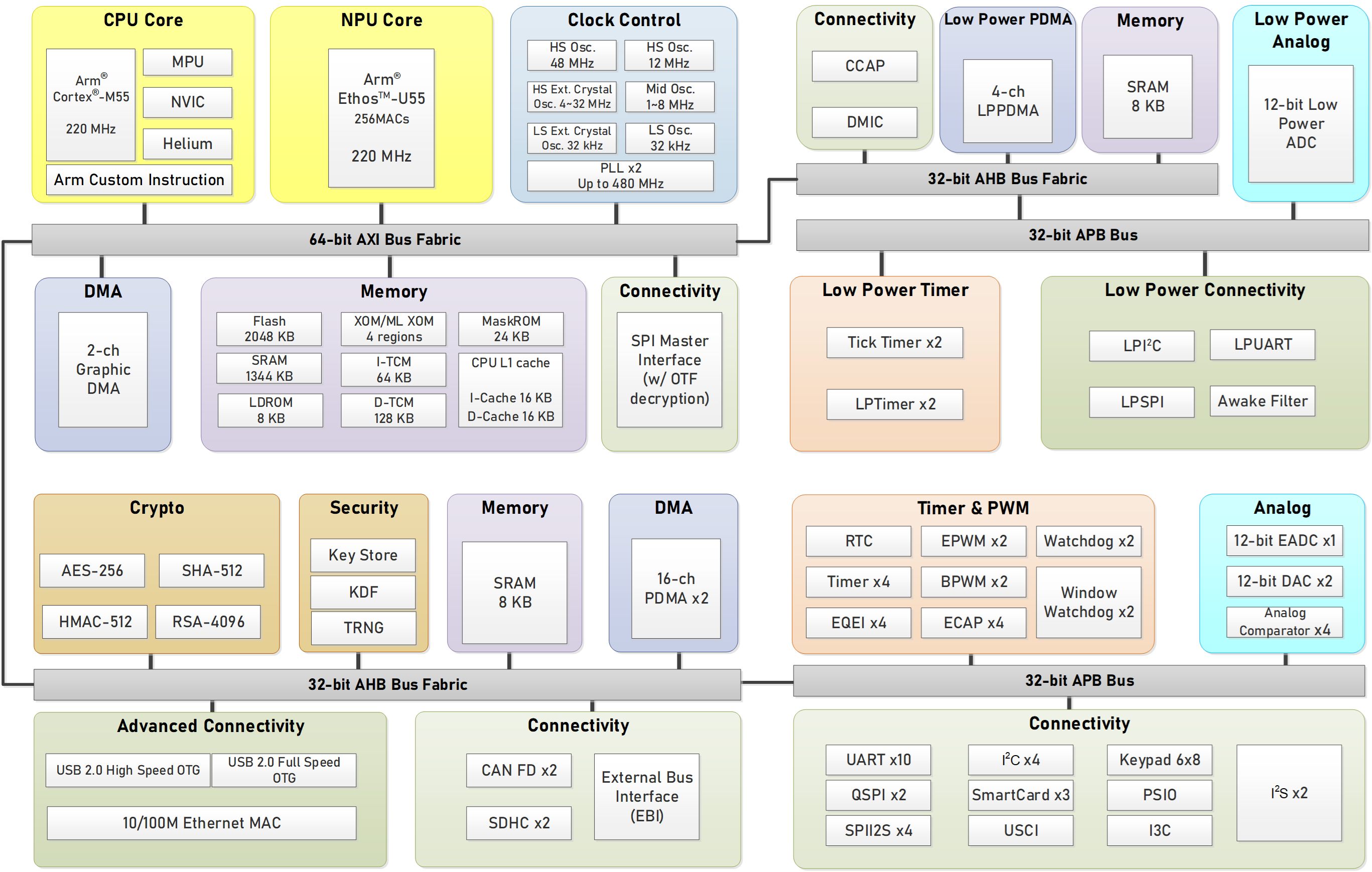
The NuMicro® M55M1R2LJAE is a new generation AI microcontroller, which delivers up to 110 GOPS of AI computing power, specifically designed for Endpoint AI such as data recognition and intelligent audio. The M55M1R2LJAE is a 32-bit microcontroller based on a 220 MHz Arm® Cortex®-M55 core, featuring an Arm® Ethos™-U55 Neural Processing Unit (NPU) as a coprocessor to accelerate neural network operations. In addition to its outstanding AI performance, the M55M1R2LJAE also includes DSP extensions, vector extensions (Helium), double-precision FPU, 2 sets of 16-channel PDMA controllers and 1 set of 2-channel GDMA controller, making it an ideal choice for embedded applications—especially those requiring intensive computation such as audio processing, communications, digital signal processing, machine learning and sensor fusion.
Flexible Memory & Expansion Options
The M55M1R2LJAE is equipped with up to 1.5 MB of on-chip RAM and 2 MB of Flash memory, and features OctoSPI and HyperBus interfaces to support the expansion of RAM and Flash memory capacity. The M55M1R2LJAE supports a low supply voltage range from 1.71V to 3.6V and operates within a temperature range of -40°C to +105°C.
Energy-Saving Design & Robust Security
For power consumption and security, the M55M1R2LJAE offers five low-power modes and supports a variety of peripherals, including CCAP, DMIC, I²C, SPI, Timer, UART, ADC, and GPIO that can continue to operate in low-power mode. In addition, the M55M1R2LJAE features multi-level security mechanisms, including secure boot, TrustZone®, TRNG, key storage, crypto accelerators, tamper detection, and PSA Certified™ Level 2 compliance, providing reliable protection for IoT and embedded applications.
Flexible IDE Compatibility and Debugging Tools
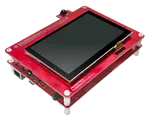
For development tool support, Nuvoton provides the NuMaker-X-M55M1D evaluation board and the Nu-Link debugger tool. In addition, it supports commonly used development environments such as Keil MDK, IAR EWARM, and Eclipse IDE with GNU GCC.
The M55M1R2LJAE benefits the design of a wide range of applications such as:
・Human presence detection
・Robotics
・Smart Toys
・Sensor Hub
・Smart Appliances
・PC Accessories
・AIoT
Key features:
Operating Characteristics
・Voltage range: 1.71V to 3.6V
・Temperature range: -40°C to +105°C
・ESD HBM ±3 kV
・EFT ±4.4 kV
・Latch Up: ±200 mA
Core
・Arm Cortex-M55 core, running up to 220 MHz
・Arm M-profile vector extension enabled (Helium)
・IEEE 754 compliant floating-point unit (FPU) supporting vector and scalar half-, single-, and double-precision floating-point calculations
・Arm TrustZone technology including an 8-region secure memory protection unit and an 8-region non-secure memory protection unit
・Arm custom instructions (ACI) implemented for accelerating specific math operations
・L1 cache: 16 KB instruction cache (I-cache) and 16 KB data cache (D-cache)
Micro-NPU
・Arm Ethos-U55 Micro-Neural Processing Unit
・Running up to 220 MHz
・256 MACs
・110 GOPS (220 MHz x 256 MACs x2)
Memories
・Secure Boot ROM (MaskROM): 24 KB
・APROM Flash: 2 MB (dual banks of 1MB each)
・LDROM Flash: 8 KB
・OTP Flash: 3 KB
・XOM (Execution-only memory): 4 regions
・SRAM0: 512 KB
・SRAM1: 512 KB
・SRAM2: 320 KB
・SRAM3: 8 KB
・LPSRAM: 8 KB
・I-TCM: 64 KB
・D-TCM: 128 KB
External Memory Interface
・SPIM (with HyperBus interface) supporting SPI Flash, QSPI, OSPI, and HyperFlash memories up to 32 MB, featuring AES on-the-fly decryption
・External bus interface (EBI) supporting 8- or 16-bit data width, i80 mode LCD interface, and up to three sets of 1 MB memory banks
Clocks
・4~32 MHz high-speed external crystal oscillator
・32.768 kHz low-speed external crystal oscillator
・48 MHz high-speed internal RC oscillator
・12 MHz high-speed internal RC oscillator with 2% deviation
・1~8 MHz high-speed internal RC oscillator
・32 kHz low-speed internal RC oscillator
・2 sets of programmable APLL, up to 480 MHz
Direct Memory Access (DMA)
・2 sets of 16-channel PDMA controllers
・1 set of 2-channel GDMA controller (DMA-350)
・1 set of 4-channel LPPDMA controller
Security Functions
・Secure Boot
・Key derivation function (KDF)
・Cryptography accelerator including algorithms up to AES-256, ECC-571, SHA-512, HMAC-512, RSA-4096, and a pseudo random number generator (PRNG)
・True random number generator (TRNG)
・Key store module for key management, including a dedicated Key store SRAM buffer
・Four eXecute-Only-Memory (XOM) regions for code protection
・Write protection in Flash memory
Power Management
・Active power: 94.5 μA/MHz at 220MHz
・Normal power-down (NPD4) with 64 KB SRAM retention: 23.26 μA at 3.0V
・Standby power-down (SPD1) with 64 KB SRAM retention: 6.1 μA at 3.0V (SRAM retention up to 64/128/192/256/320/384/448/512 KB)
・Deep power-down (RTC on): 0.74 μA at 3.0V
・RTC (VBAT): 0.51 μA
・Power-on reset
・Brown-out reset
・Low voltage reset
・Built-in LDO voltage regulators
Timer and Control Peripheral
・4 sets of 32-bit timers, supporting PWM function
・2 sets of 32-bit low power timers, supporting PWM function
・2 sets of tick timers
・1 set of 24-bit count-down SysTick timer
・2 sets of watchdog timers
・2 sets of window watchdog timers
・Up to 12 enhanced PWM (EPWM) outputs generated by twelve 16-bit counters
・Up to 12 basic PWM (BPWM) outputs generated by two 16-bit counters
・Up to 4 sets of enhanced quadrature encoder interfaces (EQEI)
・Up to 4 sets of enhanced input capture unit (ECAP)
Connectivity Interfaces
・Up to 10 sets of UART interfaces
・Up to 1 set of LPUART interface
・Up to 4 sets of I²C interfaces, up to 1 Mbps
・Up to 1 set of LPI²C interface, up to 1 Mbps
・Up to 1 set of I3C interface, up to 25 Mbps
・Up to 4 sets of SPI/I²S interfaces
・Up to 1 set of LPSPI interface
・Up to 2 sets of Quad-SPI interfaces
・Up to 1 set of USCI, supporting UART/I²C/SPI
・Up to 2 sets of SDIO interfaces
・Up to 3 sets of ISO-7816-3 smart card interfaces
・Up to 2 sets of I²S interfaces
・Up to 1 set of 8-ch programmable serial I/O (PSIO) interface
・DMIC (Digital microphone inputs), supporting 4-channel PDM interface and voice activity detection (VAD)
・6x8 Keypad Interface (KPI)
Advanced Connectivity
・Up to 2 sets of CAN FD interfaces
・USB 2.0 high speed device/host/OTG controller with dedicated DMA and on-chip PHY, supporting power delivery (PD) function
・USB 2.0 full speed device/host/OTG controller with on-chip PHY, supporting crystal-less at device mode
・10/100 Ethernet MAC with RMII interface, supporting IEEE 1588 v2 precision time protocol
Low Power Peripherals
・LPSRAM: 8 KB
・Up to 1 set of LPUART interface
・Up to 1 set of LPI²C interface, up to 1 Mbps
・Up to 1 set of LPSPI interface
・1 set of 4-channel LPPDMA controller
・2 sets of 32-bit low power timers, supporting PWM function
・1 set of 12-bit, up to 24-ch, 2 Msps SAR LPADC
Camera Capture Interface Controller (CCAP)
・Resolution up to 640x480 pixels
・Supports motion detection engine with 320x240 image data in Power-down mode
Analog Peripherals
・1 set of 12-bit, up to 24-ch, 5 Msps SAR ADC
・1 set of 12-bit, up to 24-ch, 2 Msps SAR LPADC
・Up to 2 sets of 12-bit, 1 Msps buffered DAC
・Up to 4 sets of analog comparators (ACMP)
・Built-in internal reference voltage
・Built-in temperature sensor
Cyclic Redundancy Calculation (CRC)
Real Time Clock (RTC), Tamper and VBAT Power Domain
・Supports independent VBAT power pin for RTC and tamper detection
・Supports calendar RTC
・Backup registers: 80 bytes
・Tamper detection: 6 pins
I/O Features
・Up to 39 GPIO with interrupt capability
・GPIO with internal pull-up / pull-down resistor
96-bit Unique ID (UID)
128-bit Unique Customer ID (UCID)
Package
・Package is Halogen-free, RoHS-compliant and TSCA-compliant.
Datasheet